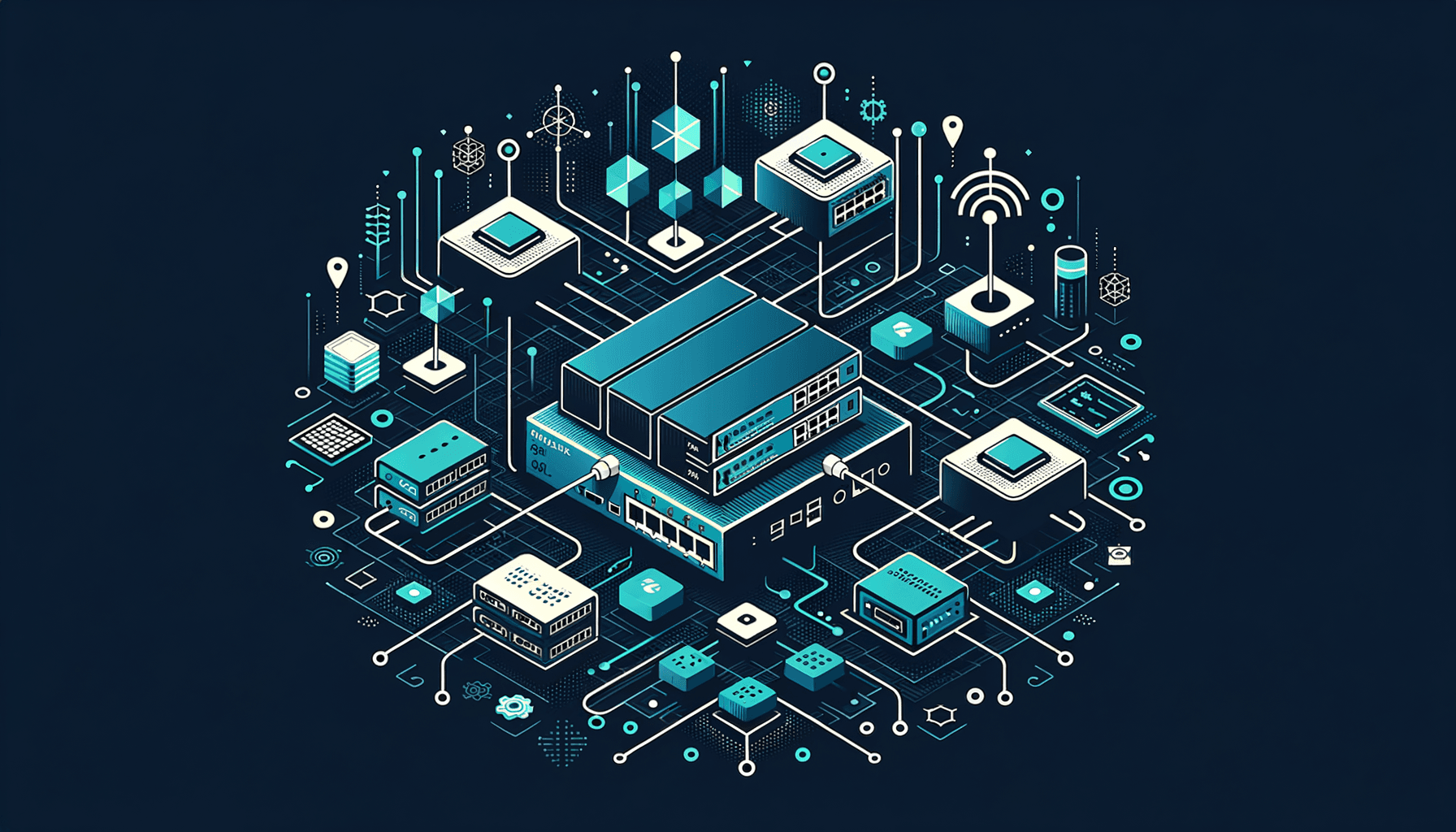
Network architecture is the structural design framework that defines how computers, servers, and network devices interconnect, communicate, and protect data within an organization. For small businesses, proper network architecture represents the fundamental difference between containing a security incident to a single device and experiencing a catastrophic breach that compromises every system.
Modern threat actors specifically target small and medium businesses (SMBs) because they typically deploy "flat networks"—architectures where all devices share the same network segment with minimal access controls or segmentation. This design allows ransomware and malware to move laterally across every system once a single device is compromised.
This comprehensive guide provides enterprise-grade network architecture principles scaled for small business budgets, compliance requirements, and operational constraints. You'll learn the specific architectural models that prevent data breaches, the exact hardware and software components required for regulatory compliance, and actionable implementation steps with realistic cost projections based on 2025 market rates.
Key Takeaway
Design a secure network for your small business. Segmentation, firewall configuration, Wi-Fi security, and remote access best practices.
Understanding Network Architecture Fundamentals
Network architecture defines the logical and physical arrangement of network components—including routers, switches, firewalls, access points, and servers—and the protocols and policies that govern data transmission between them. The architecture determines three critical security factors that directly impact breach prevention and regulatory compliance:
- Access control: Which users and devices can reach which resources, enforced through authentication protocols and firewall rules
- Segmentation: How network zones are isolated to contain breaches and prevent lateral movement
- Visibility: What network traffic can be monitored, logged, and analyzed for threat detection
The National Institute of Standards and Technology (NIST) Cybersecurity Framework identifies network architecture as a foundational control in the "Protect" function, specifically requiring organizations to separate network environments based on data sensitivity and operational requirements. NIST Special Publication 800-171 mandates network segmentation for any organization handling Controlled Unclassified Information (CUI), affecting thousands of small businesses in the defense supply chain, healthcare sector, and financial services industries.
Network Security Impact by the Numbers
Flat networks vs segmented networks
On flat networks (100% of systems)
With proper VLAN segmentation
Network Segmentation Benefits
71% Lateral Movement Blocked
Proper VLAN segmentation prevents malware spread between network zones
89% Ransomware Reduction
Segmented networks contain ransomware to initial infection point
Compliance Alignment
Meets PCI DSS, HIPAA, and FTC Safeguards Rule requirements
2. Segmented Network Architecture (Minimum Acceptable Standard)
Network segmentation divides a flat network into multiple logical zones using VLANs (Virtual Local Area Networks) and firewall rules. Common segments include designated zones for different trust levels and data sensitivity requirements:
- User VLAN: Employee workstations and standard productivity applications
- Server VLAN: File servers, databases, and business applications
- Guest VLAN: Visitor WiFi with internet-only access, isolated from corporate resources
- IoT VLAN: Printers, security cameras, HVAC systems, and building automation
- Management VLAN: Network infrastructure administration and security tools
Security benefit: According to a managed security solution Networks 2025 Security Research, proper VLAN segmentation blocks 71% of lateral movement attempts by malware and reduces ransomware spread by 89%, translating to average breach cost reductions of $2.1 million.
Implementation cost: $500-$2,000 for managed switches and firewall configuration (10-25 employee business)
Compliance alignment: Meets PCI DSS segmentation requirements, HIPAA access control standards, and FTC Safeguards Rule network isolation mandates when properly configured with inter-VLAN firewall controls.
3. Zero Trust Network Architecture (Recommended Modern Standard)
Zero Trust Architecture (ZTA) operates on the principle "never trust, always verify." Rather than assuming devices inside the network perimeter are safe, Zero Trust requires authentication and authorization for every connection attempt, continuously validates security posture, and grants access based on least-privilege policies.
The National Security Agency (NSA) published "Embracing a Zero Trust Security Model" in 2021, recommending ZTA as the baseline for all organizations handling sensitive data. NIST Special Publication 800-207 provides the definitive Zero Trust implementation framework with specific technical controls and architecture patterns.
Security benefit: Microsoft's 2024 Zero Trust Adoption Report found that organizations with mature ZTA implementations experienced 94% fewer successful phishing attacks and 76% faster incident response times, with average breach costs 68% lower than organizations using perimeter-based security models.
Implementation cost: $2,000-$10,000 initial setup; $100-$500/month ongoing for identity management and access control platforms
Timeline: 60-90 days for phased implementation starting with critical assets and highest-risk user populations.
Network Architecture Model Comparison
| Feature | Architecture Type | Security Level | Implementation Cost | RecommendedBest For |
|---|---|---|---|---|
| Flat Network | Critical Risk | $0 | Immediate replacement required | — |
| Segmented (VLAN) | Minimum Standard | $500-$2,000 | Small businesses, compliance | — |
| Zero Trust | Recommended | $2,000-$10,000 | Modern security standard | — |
| SASE | Advanced | $15-$50/user/month | Cloud-first, remote workforce | — |
4. Software-Defined Perimeter (Cloud-Optimized Architecture)
Software-Defined Perimeter (SDP) creates "black cloud" network infrastructure where resources are hidden from unauthorized users and only become visible after identity verification. SDP is particularly effective for businesses with distributed workforces and cloud-based applications that require secure access without traditional VPN infrastructure.
How SDP works: Rather than connecting to the corporate network, remote users authenticate to a controller that creates encrypted micro-tunnels to specific applications. Unauthorized users cannot even discover what network resources exist, eliminating reconnaissance and reducing the attack surface visible to external threats.
Security benefit: Eliminates network-based reconnaissance and reduces the attack surface visible to external threats by 99%. Cloud Security Alliance research shows SDP reduces successful DDoS attacks by 97% because no network infrastructure is exposed to the internet for scanning or exploitation.
Best use cases: Remote workforce, cloud-first businesses, organizations with high-value intellectual property, and companies requiring granular application-level access controls
Cost structure: $15-$50 per user per month for SDP platform (Perimeter 81, Twingate, Zscaler Private Access)
5. SASE (Secure Access Service Edge)—Converged Cloud Architecture
SASE combines network security functions (secure web gateway, firewall, ZTNA, data loss prevention) with wide-area networking (SD-WAN) in a unified cloud platform. Gartner coined the term in 2019 and predicts 60% of enterprises will have explicit SASE adoption strategies by 2025, with small businesses increasingly adopting SASE to reduce infrastructure complexity.
Security benefit: Forrester's Total Economic Impact study of SASE found organizations achieved 43% reduction in security incidents and 61% faster threat response compared to traditional hub-and-spoke architectures, with total cost of ownership reductions of 35-50% over three years.
Implementation timeline: 30-90 days for migration from traditional architecture
ROI: Average 25% reduction in total IT and security costs within 24 months (elimination of VPN, firewall, and multiple security tool costs)
Critical Network Vulnerabilities
The three most dangerous network architecture vulnerabilities that require immediate attention: flat network design (no segmentation), default credentials and configurations, and lack of east-west traffic visibility. These vulnerabilities are actively exploited by ransomware groups and can lead to complete business compromise within hours.
Vulnerability #2: Default Credentials and Configurations
Risk description: Network devices shipped with factory default usernames, passwords, and security settings. Shodan.io—a search engine for internet-connected devices—indexes over 2.3 million exploitable devices daily, most accessible due to default credentials that manufacturers publish in publicly available documentation.
Common defaults still in production:
- admin/admin on routers and switches
- SNMP community string "public" with read-write access
- Default VLANs (VLAN 1) for management traffic
- Unnecessary services enabled (Telnet, HTTP management, UPnP)
Compliance violation: PCI DSS Requirement 2.1 explicitly requires changing all vendor-supplied defaults before deploying systems on the cardholder data environment. HIPAA Security Rule § 164.308(a)(5)(ii)(B) requires periodic technical and nontechnical evaluation of security controls, including default configurations.
Vulnerability #3: No East-West Traffic Visibility
Risk description: Organizations monitor north-south traffic (internet-to-internal) but ignore east-west traffic (server-to-server, workstation-to-workstation). According to Forrester Research, 80% of data center traffic is east-west, yet 90% of security controls focus on north-south, creating a massive blind spot for lateral movement detection.
Exploitation scenario: Attackers establish initial access through phishing, then spend an average of 287 days (IBM X-Force Threat Intelligence Index 2025) moving laterally through unmonitored internal networks before deploying ransomware or exfiltrating data to external servers.
Detection gap: Traditional perimeter firewalls cannot inspect traffic between internal systems. Internal lateral movement remains invisible until backup failures or ransom notes appear, by which time attackers have already compromised critical systems and exfiltrated sensitive data.
Cost range: $500-$5,000 depending on approach (VLAN firewalling to full micro-segmentation)
30-Day Network Security Implementation Plan
Phase 1: Discovery and Planning (Days 1-7)
Network inventory and mapping, data flow analysis, and architecture design. Use discovery tools to identify all devices, document data flows, and create VLAN structure based on data sensitivity.
Phase 2: Infrastructure Deployment (Days 8-14)
Configure firewall with VLAN interfaces, implement VLANs on managed switches, and set up WiFi segmentation with separate corporate and guest networks.
Phase 3: Access Controls and Monitoring (Days 15-21)
Deploy 802.1X authentication, integrate with Active Directory, implement network monitoring platform, and configure vulnerability scanning.
Phase 4: Advanced Security and Documentation (Days 22-30)
Enable IDS/IPS, create comprehensive documentation, conduct internal penetration testing, and establish incident response procedures.
Implementation Costs by Business Size
10-25 employees, includes firewall, switches, WiFi
25-100 employees, enterprise-grade equipment
Licensing, monitoring, managed services
Advanced monitoring, MDR, compliance testing
HIPAA (Health Insurance Portability and Accountability Act)
Healthcare organizations and their business associates must implement the HIPAA Security Rule network security standards:
- § 164.312(a)(1) Access Control: Implement technical policies and procedures that allow only authorized persons to access electronic protected health information (ePHI)
- § 164.312(b) Audit Controls: Implement hardware, software, and procedural mechanisms that record and examine activity in information systems containing ePHI
- § 164.312(c)(1) Integrity: Implement policies and procedures to protect ePHI from improper alteration or destruction
- § 164.312(e)(1) Transmission Security: Implement technical security measures to guard against unauthorized access to ePHI transmitted over electronic networks
HHS Office for Civil Rights (OCR) enforcement priorities: The OCR's 2024-2025 audit protocol specifically examines network segmentation, access controls, and encryption for data in transit.
Violation penalties: $100-$50,000 per violation (with annual maximum of $1.5 million per violation category); criminal penalties up to $250,000 and 10 years imprisonment for knowing misuse.
FTC Safeguards Rule (Gramm-Leach-Bliley Act)
Financial institutions must implement the updated Safeguards Rule (effective June 2023) requiring specific network security controls:
- 16 CFR § 314.4(c) Access Controls: Implement access controls based on least privilege, including network-level access restrictions
- 16 CFR § 314.4(e) Data Inventory: Maintain an inventory of systems and data flows, which requires understanding network architecture
- 16 CFR § 314.4(g) Monitoring: Implement continuous monitoring of network activity to detect unauthorized access
- 16 CFR § 314.4(h) Encryption: Encrypt customer information in transit over external networks
FTC enforcement actions: The FTC has brought enforcement actions against tax preparers, auto dealers, and financial advisors for inadequate network security, resulting in mandatory third-party audits, civil penalties, and consent decrees.
IoT Device Security Best Practice
Internet of Things (IoT) devices—including IP cameras, smart thermostats, badge readers, and printers—present unique security challenges: they rarely receive security updates, often have default credentials, and manufacturers prioritize functionality over security. Always isolate IoT devices in a dedicated VLAN with firewall rules preventing lateral movement to corporate systems.
Practical IoT Device Security Architecture
The CISA Securing IoT Products guide provides additional recommendations for manufacturers and network administrators. Traffic flow rules: Implement firewall rules allowing necessary communication from lower-trust to higher-trust zones only after authentication and authorization. Block all lateral movement within the same zone except for explicitly permitted services.
Take Action: Transform Your Network From Liability to Defense Asset
Network architecture vulnerabilities remain the leading entry point for ransomware, data breaches, and business disruption. Every day you operate with a flat network or inadequate segmentation is another day attackers can map your entire infrastructure from a single compromised device.
The difference between a four-hour contained incident and a business-ending breach is determined by decisions you make today about network design, segmentation, and monitoring. Organizations with proper network architecture contain incidents 68% faster and reduce breach costs by an average of $2.3 million compared to those with flat networks (IBM Security 2025).
Immediate action steps (start today):
- Run a network discovery scan to inventory all connected devices (use free tools like Angry IP Scanner or Advanced IP Scanner)
- Log into your firewall and review current rules—if you see "allow any any" rules, flag for immediate remediation
- Test guest WiFi isolation: from a guest device, attempt to ping or access a corporate workstation by IP address (if successful, segmentation is inadequate)
- Check switch configuration for VLANs—if everything is on VLAN 1, you have a flat network
- Document your most sensitive data locations (customer databases, financial systems, intellectual property)
- Schedule a 30-minute consultation with a network security professional to review findings
Don't wait for a breach to expose your network's weaknesses. Proper architecture is not an expense—it's the difference between recovering from an incident in hours versus going out of business. The attackers are already scanning for vulnerable small business networks. Make sure yours isn't the easy target they're looking for.
Frequently Asked Questions
Yes, with proper planning and phased implementation. Plan segmentation changes during off-peak hours or weekends, implement one VLAN at a time, and test thoroughly before moving to the next segment. Start with the easiest wins—guest WiFi segmentation and IoT device isolation—which require no changes to user workstations. Most small businesses complete full segmentation over 2-3 weekend implementation windows with minimal user impact. The key is detailed planning: document the current state, design the target architecture, create detailed rollback procedures before making changes, and communicate with users about expected downtime windows.
The primary differences are throughput capacity, concurrent session limits, advanced security features, and support quality. A $500 firewall (such as Ubiquiti Dream Machine Pro) typically handles 20-50 users with 1-2 Gbps throughput, basic firewall rules, and IDS/IPS with limited threat intelligence. A $5,000 firewall (a managed security solution FortiGate 200F, a managed security solution PA-440) supports 200+ users with 5+ Gbps throughput, AI-based threat detection, advanced malware sandboxing, application control, SSL/TLS decryption, and includes vendor support with guaranteed response times. For businesses under 25 employees with standard office applications, mid-range firewalls ($1,200-$2,500) provide an optimal security-to-cost ratio with sufficient capacity for growth and advanced security features.
Ask these three diagnostic questions: (1) Can any employee access all network resources without restriction? (2) Can you track who accessed what file or system at what time? (3) If malware infected one workstation, would it automatically spread to others? If you answered yes, no, yes—your architecture needs immediate remediation. For objective assessment, conduct a vulnerability scan using OpenVAS or a vulnerability scanner, review your firewall rules (if everything is "allow any any," that's a critical finding), and run a penetration test to validate whether segmentation actually contains attacks. Consider engaging a professional for comprehensive evaluation of your network security posture.
Increasingly yes, especially for businesses with distributed workforces. Cloud-native architectures with SASE eliminate many traditional on-premises vulnerabilities and reduce capital expenditures for hardware. However, most businesses maintain hybrid architectures: cloud-based email and productivity (Microsoft 365, Google Workspace), SaaS business applications, but on-premises file servers, printers, and specialized equipment. The optimal approach depends on your industry compliance requirements—healthcare organizations handling ePHI often maintain on-premises architecture for data residency, while professional services firms operate successfully with 100% cloud infrastructure. Evaluate SASE platforms (Cato Networks, a managed security solution Prisma SASE, Zscaler) for simplified cloud-centric security.
The five most common segmentation failures are: (1) Creating VLANs but allowing unrestricted inter-VLAN routing (defeating the purpose of segmentation), (2) forgetting to segment WiFi networks separately from wired networks, (3) placing administrative accounts in the same segment as regular users (allowing privilege escalation), (4) not documenting firewall rules and allowing rule sprawl over time, and (5) failing to test segmentation effectiveness with penetration testing. The solution: implement firewall filtering between all VLANs, treat WiFi as untrusted, use jump boxes in a management VLAN for privileged access, quarterly firewall rule audits, and annual penetration tests specifically targeting lateral movement.
Remote-first organizations should prioritize Zero Trust Network Access (ZTNA) over traditional VPNs. Rather than granting remote users full network access (which recreates a flat network vulnerability over the internet), ZTNA provides identity-verified, device-verified access to specific applications. Implement SASE for comprehensive security (secure web gateway, firewall, ZTNA, data loss prevention) delivered from the cloud. For the office location, focus on protecting cloud application access rather than perimeter defense: deploy secure web gateways, implement conditional access policies requiring MFA and compliant devices, and monitor for cloud application data exfiltration.
Protect Your Business From Cyber Threats
Schedule a free cybersecurity assessment to identify vulnerabilities and build a protection plan.
Free Consultation
Is your business protected?
Most small businesses discover vulnerabilities only after an attack. Get ahead of the threat.